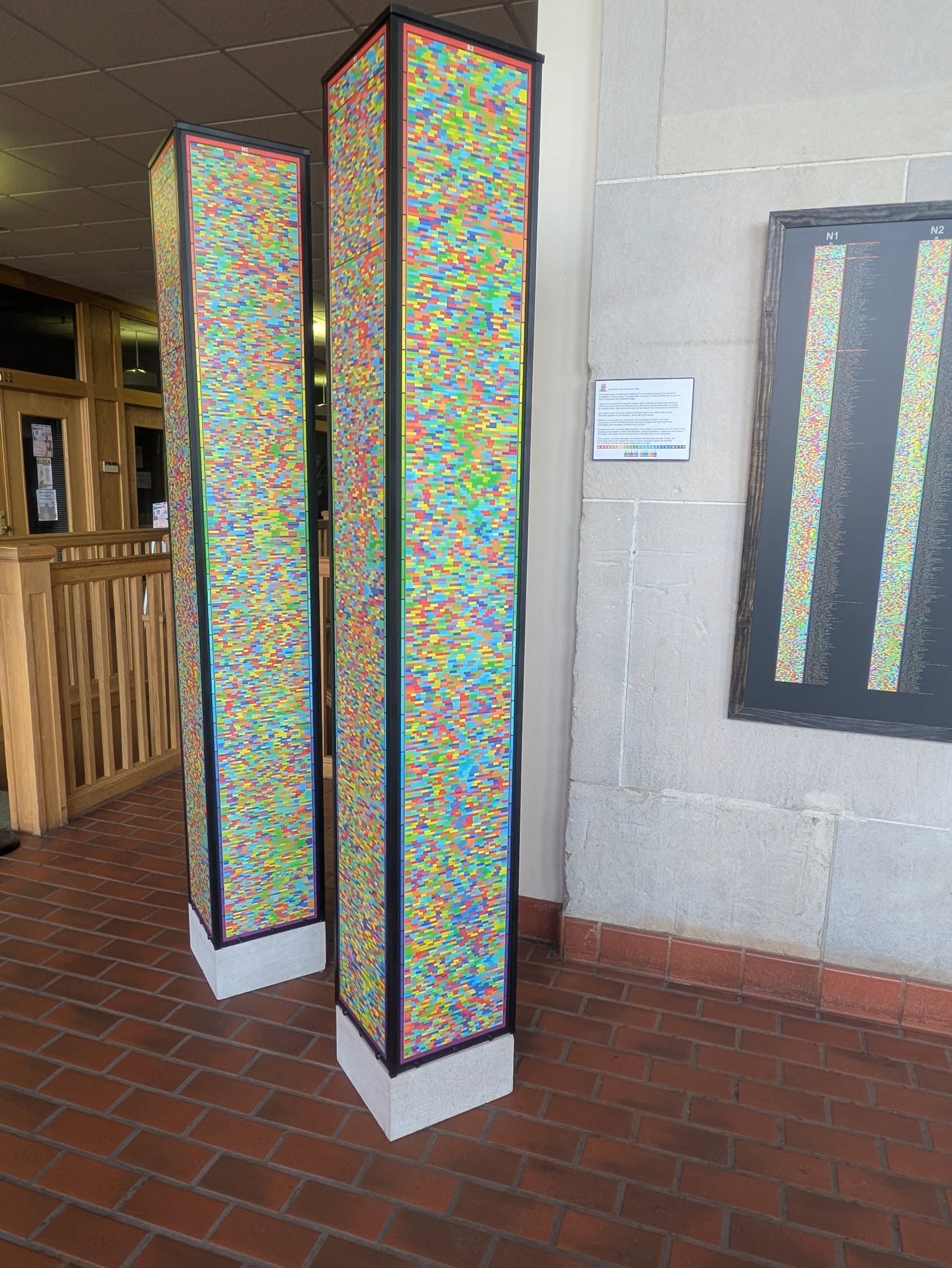
As the nation marks the 25th anniversary of September 11, Tell City artist Jerry Collins is using color, creativity, and nearly 3,000 names to remind us that behind every name was a life, a family, and a story worth remembering.
Sometimes, an idea begins with something as simple as two towers standing side by side.
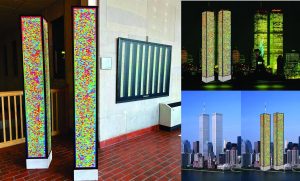
For Tell City artist Jerry Collins, that moment came while working at a sign shop in the mid-2010s. The shop was preparing two tall, blank pylons that would eventually feature Indiana University graphics. Looking at the structures, Collins immediately thought of the Twin Towers.
At the time, he had already been exploring a unique approach to art: creating pieces that could literally communicate a message through a color-coded alphabet. He had used the concept to celebrate milestones such as graduations and anniversaries, but the image of those two pylons sparked something much bigger.
The two ideas came together, and the vision for a September 11 memorial began to take shape.
What followed was a deeply personal, years-long project that would transform nearly 3,000 names into a striking visual tribute to the lives lost on September 11, 2001.
A Personal Connection to an Unthinkable Tragedy
For Collins, September 11 was not simply a moment in American history. It also carried a connection to his hometown of Tell City, Indiana.
Stacey Peak, a Tell City native who worked as a broker in the North Tower, was among those who lost their lives that day. Although Collins and Peak had not known each other well, he remembered speaking with her on more than one occasion.
He recalled learning of her involvement in the tragedy days after the attacks, during a period of stunned disbelief. Discovering that someone from his own hometown had been lost made an already unimaginable event feel even more personal.
Even without a close relationship, her death brought home just how far the tragedy reached.
It was a reminder that September 11 affected people everywhere, including small communities far removed from New York City.
That understanding would become an important part of the memorial’s meaning: every name represented not just a victim, but a network of family members, friends, coworkers, and communities forever changed by the loss.
The Names Behind the Numbers
The idea for the memorial grew as Collins began researching the victims.
One September 11 anniversary, while listening to a radio broadcast reading the names of those who had died, he decided to look up one of the names he had just heard. What he discovered raised questions about the accuracy of the list being read and prompted him to investigate the official records more closely.
That research led him to the National September 11 Memorial & Museum website, where visitors can explore victims’ biographies and search by name, birthplace, residence, and other details.
The stories he found were heartbreaking and eye-opening.
Among the names were people connected to Indiana and Kentucky, along with countless others from small towns across the country. The victims came from different backgrounds, professions, and communities, but each had a life that mattered to someone.
The research made the scale of the tragedy even more meaningful. Nearly 3,000 lives were lost, but those numbers could never fully communicate the individual stories behind them.
Collins began to understand that the memorial needed to do more than represent the magnitude of the attacks. It needed to honor the people themselves.
“These people aren’t just numbers,” Collins explained. Each person had a distinct story, a family, ambitions, and a future. Every name represented a life interrupted and a community left to navigate an unimaginable loss.
The tragedy was not simply one collective event. It was thousands of personal catastrophes happening at once.
Turning Nearly 3,000 Names Into Art
The physical and emotional scope of the project was immense.
At first, Collins worked on the memorial a little at a time, laying out names and making steady progress. When the COVID-19 pandemic brought a period of time at home, he was able to devote more attention to the project. It was then that he realized just how much work remained.
He decided to change his approach and focus on making measurable progress. Rather than attempting to tackle the entire list at once, he began with the crew members and passengers aboard each of the four planes involved in the attacks.
Completing each list provided a sense of accomplishment and helped move the larger project forward.
But the work was rarely just about placing letters.
As Collins researched individual victims to verify names and spellings, he often found himself reading about their lives, their final moments, and the families who survived them. Those stories were difficult to leave behind, even when he knew he needed to keep working.
The process became an emotional balancing act between honoring each individual story and completing the monumental task in front of him.
And then, during one of those moments when he was working through a long stretch of names, something happened that stopped him in his tracks.
The Moment He Spelled Stacey Peak’s Name
While laying out the names, Collins would sometimes deliberately avoid researching each person so he could make faster progress. He would move from one letter to the next, concentrating on completing a section rather than stopping to read another biography.
During one of those stretches, he looked at the letters he had just placed and realized he had spelled out Stacey Lynn Peak.
The name of the woman from his hometown had appeared before him almost unexpectedly.
He had spent so much time thinking about the individual lives represented in the memorial, and he had known Stacey’s name from the beginning. Yet seeing it emerge in the artwork in that unplanned moment made him stop and take it in.
It was a powerful reminder of why he had undertaken the project in the first place.
Stacey was not simply one name among thousands. She was a person from Tell City, someone Collins remembered talking with, and someone whose loss had made the tragedy feel closer to home.
Her name appearing in the memorial brought the project’s personal meaning into sharp focus.
An Alphabet Built From Color
The memorial’s visual impact comes from an unusual technique Collins developed using a color-coded alphabet.
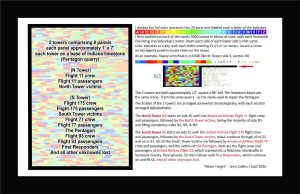
His original alphabet was created from the full visible color spectrum. Using a computer, he arranged 26 equal blocks, assigned a letter of the alphabet to each block, and stretched a rainbow spectrum across the row. The letter A began at the red end, with each successive letter taking its color from the spectrum until Z reached the violet end.
That color alphabet became the foundation for the memorial.
Each letter carries its own color, allowing thousands of names to form patterns across the two towers. The result is a piece that can be appreciated visually while still communicating something specific and deeply significant.
The colors are not merely decoration. They are part of a system that allows the artwork to say something.
For viewers, the towers offer an opportunity to see the memorial from two perspectives: as a striking work of art and as a collection of individual names, each representing a life lost. The contrast between the vibrant colors and the tragedy they commemorate is central to the piece’s message.
More Than Mourning: A Celebration of Life
When asked what he hopes people will see when standing in front of the finished installation, Collins’ answer goes beyond remembering the destruction of September 11.
He hopes younger generations, particularly those who were not yet born or were too young to remember that day, will begin to understand the magnitude of the tragedy. But he also hopes they recognize something else: despite our differences, we have more in common than we sometimes realize.
The victims were not defined solely by the circumstances of their deaths. They were vibrant, unique individuals whose lives were filled with relationships, experiences, hopes, and possibilities.
That is why Collins sees the installation as a celebration of life as much as an act of mourning.
By focusing on the people rather than simply the scale of the tragedy, the memorial encourages visitors to look beyond the statistics and consider the lives behind each name.
For those who knew very little about September 11, Collins hopes the experience offers a deeper understanding of the individuals who were lost. For those who remember the day clearly, it provides another way to reflect on a moment that changed so many lives.
Twenty-Five Years Later, We Still Must Remember
A quarter-century after September 11, the memorial carries a message that remains as important as ever.
When asked what we most need to remember 25 years later, Collins offered a simple answer:
“We need to remember, period. Never Forget.”
The words are familiar, but the memorial gives them a deeply human meaning. Remembering is not just about recalling where we were that day or revisiting the images that became part of our collective history. It is also about remembering the people whose lives were taken and the families and communities that continue to carry their absence.
Nearly 3,000 names fill the memorial, but no two lives were the same. Each person had a story. Each person mattered.
Through two towers, a spectrum of color, and thousands of carefully placed letters, Collins invites visitors to pause, reflect, and recognize the humanity behind every name.
Because the ultimate message is not only about how those lives ended.
It is about how they lived.
And why we must never forget.












Comments